
Hi, I’m James. Thanks for checking out Building Momentum: a newsletter to help startup founders and marketers accelerate SaaS growth through product marketing.
Get the next post in your inbox
Practical product marketing and GTM ideas, weekly.
Ready to think like a strategic Product Marketer?
The GTM Playbook is a hands-on course designed to help startup marketers build stronger judgment and GTM confidence. Live cohort access included from February 24th.
Explore the curriculum →
Most sales teams say they sell value, but in practice, they sell features wrapped in vague ROI claims, backed by hand-wavy maths and optimistic assumptions.
Buyers nod along… until they stall, ask for discounts, or say they need to “think about it”.
One of the biggest challenges I see PMMs, sales teams, and founders struggling with is how to create urgency with prospects; how to create an undeniable ‘pull’ motion, rather than trying to ‘push’ sales conversations like a heavy rock up a hill.
Early in my career I joined a company called Emailvision (later rebranded as SmartFocus), through the acqusition of PredictiveIntent – my first startup where I was employee number 4, the first marketer.
SmartFocus was sizable: thousands of customers, 650+ employees, and more than a dozen offices globally. My job was to roll this new product out to an existing sales organisation and help them sell it into the existing customer base.
It was a great success: we signed 40 customers to the new product within the first 6 months of rollout, getting to $1m ARR in record time.
Looking back, one sales tool + narrative helped lower barriers to entry, increase value perception, and make it a no-brainer to say yes. We built a tight process for generating customer-specific, evidence-led value cases.
This post breaks down the exact approach we used, why it worked, and how you can apply the same mechanics to your own product.
As a product marketer, your job is not to write broad ROI claims as part of your positioning and messaging. Your job is to help build the sales narrative that move a prospect along the buyer journey.
Designing a value case that reps can safely co-create with buyers, using the buyer’s numbers, assumptions, and constraints is a great way to deliver impact.
In this post:
The real job: make value tangible
Smart Focus Advisor (the rebranded PredictiveIntent product) was a revenue-generating product. That should have made it easy.
Alas, it did not.
The PredictiveIntent technology was early AI and ‘big data’ number crunching designed to recommend ‘you might also like’ products on ecommerce stores by looking at thousands of similar customers like you.
With just a few lines of javascript, retailers could add recommendation blocks that would ‘be relevant and drive incremental revenue’.
But it sounds abstract… until you translate it into numbers that matter to a buyer: revenue, waste, targets, and trade-offs.
The turning point came from working closely with a sales rep who was unusually good at building business cases. We iterated together, systemized what worked, and taught it across the sales team.
The entire process had a few non-negotiable principles baked in:
Build trust before you build maths
Start with low stakes, then go deeper
Use the customer’s numbers, not yours
Anchor everything to monthly and annual impact
Show the experience, not just the outcome
Step 1: Build trust before asking for numbers
I have never given deep company insights to a sales rep I don’t trust.
So the first move in any sales conversation was always to lower the stakes.
We framed the exercise as diagnostic, not transactional.
The language mattered:
“We want to understand where you are today so we can suggest a few ideas on how you can grow revenue with personalization. This is not a proposal, and your data won’t be shared or aggregated.”
That framing did three things:
Signalled genuine intent to help
Removed pressure to commit
Made sharing data feel safe
Step 2: Start with a few pivotal inputs
We never asked for everything upfront.
We started with a small set of numbers that had an outsized impact on the model. Ballparks were fine.
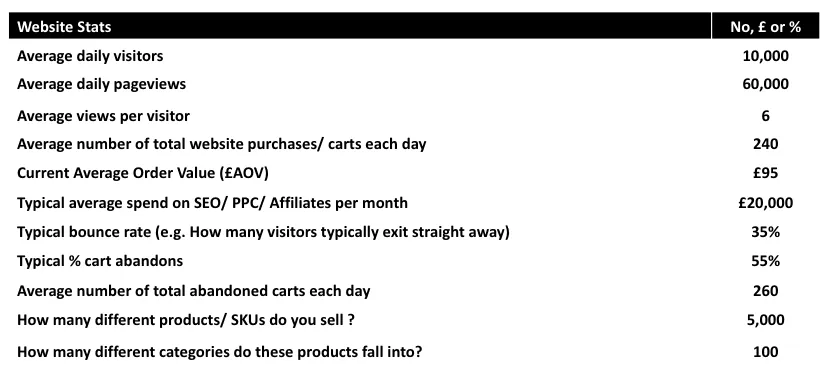
For SmartFocus Advisor, that meant questions like:
Average daily visitors
Average daily page views
Purchases per day
Current average order value
If a prospect shared only these, we could already sketch a rough revenue baseline.
Once momentum built, we invited them to go deeper:
Monthly SEO, PPC, and affiliate spend
Bounce rate
Cart abandonment rate
Number of abandoned carts per day
Number of products and categories
Step 3: Establish the revenue baseline
With a handful of inputs, we anchored the conversation in reality: to revenue.
Example logic:
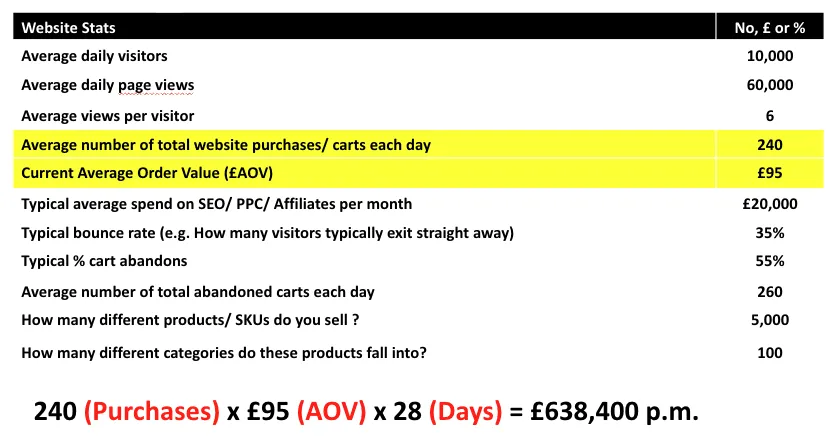
Purchases per day × average order value = average daily revenue
Daily revenue × 28 = monthly revenue estimate
Monthly revenue × 12 = annual revenue estimate
This was not presented as exact. It was presented as accurate enough to reason with, with an obvious margin for error and excluding seasonality.
Step 4: Expose waste without judgement
Next, we looked at traffic and spend.
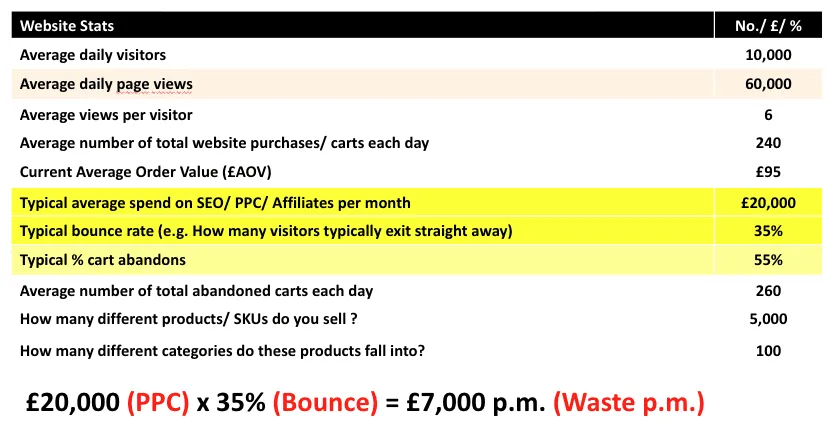
Average daily page views × 28 = monthly page views
PPC/SEO/Affiliate spend × bounce rate = wasted spend
If a customer spent £20,000 per month on PPC with a 35 percent bounce rate, roughly £7,000 went to visitors who never engaged with the site.
We framed it as structural inefficiency that every large site has – an opportunity to present an upside in ‘lost’, but committed, spending.
Waste reframed the product from “new investment” to “better use of what you already spend” – even if the argument is hybrid.
Step 5: Make the solution visible
Buying a solution that has any impact on end-user UX can be risky enough – doubly so if you’re trying to combine it with an abstract, hard to trust uplift. So we made the experience real.
Because we had data across many customers, we could estimate page view distribution by page type:
Homepage
Category pages
Product pages
Checkout
We took screenshots of the prospect’s site and overlaid design examples showing how SmartFocus Advisor would appear in each context.
This did two things:
Reduced fear of disruption
Anchored uplift to specific surfaces
The buyer could see where value would be created.

Step 6: Apply credible uplift assumptions
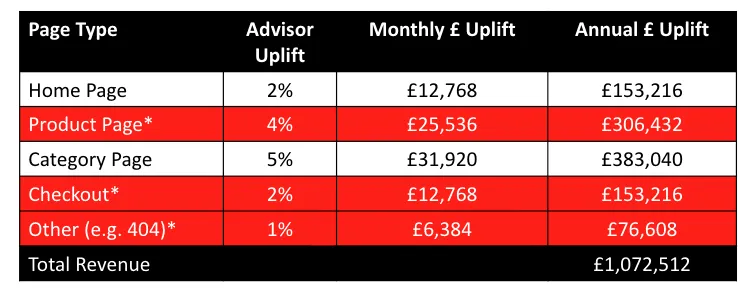
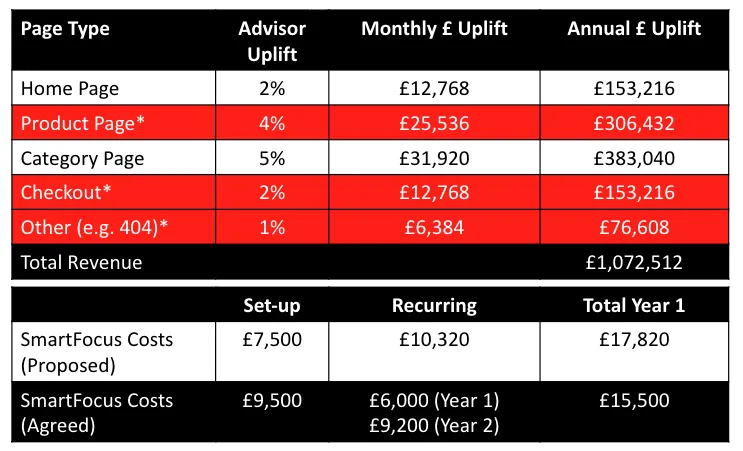
Uplift is where most business cases collapsee, so we avoided aggressive promises. We used conservative ranges based on live customers.
Each uplift was calculated separately, then rolled up into monthly and annual potential revenue figures – because no only do bigger numbers sell better, but because buyers have monthly and annual targets in mind.
Step 7: Offer a low-effort wedge
While we pushed for a full rollout, the model made it easy to propose a pilot:
One page type
One clear success metric
This reframed the decision from a bet to a test – especially useful in selling to existing install bases who trust you for one product already, and to low-margin retailers with high-risk spend.
Step 8: Map value against cost
Only at the end did we introduce pricing.
Setup fees
Recurring fees
Year one total cost
Any discounts against ratecard
All against the estimated incremental revenue uplift.
Who wouldn’t spend £15k to make between £75k and £1m of incremental revenue?
How product marketers can build business case tools and ROI calculators
Value cases, ROI calculators etc are often treated as sales tools – but they’re actually product and narrative infrastructure.
In practice, PMMs should own:
The input model: Which numbers matter, which are optional, and which unlock deeper insight
The assumptions: What counts as a credible uplift, the proof, and defensible ranges that don’t spark lack of trust
The artifacts: Worksheets, online tools, and the slides that guide the conversation without scripting it
Sales then take these tools to apply their unique sales skills to every prospect:
The pacing of the conversation
The judgement of when to go deeper
The relationship and trust-building
When done well, ROI calculators reduce pressure, rather than adding it. It becomes easier to showcase potential, realistic value wihle reps don’t need to defend price: it becomes all about the upside.
Why I think this worked
In my opinion, we respected the buyer throughout, by:
Identifying the smallest set of inputs they would feel comfortable sharing
Approaching the conversation in a low-pressure, diagnostic frame
Translating numbers into the metrics they cared most about
Show where waste exists, not just where upside lives
Grounding the uplift in realistic mockups
Anchoring ROI in conservative, explainable assumptions
Offering a pilot as an initial wedge, as well as a full commitment to the complete solution
Value cases are powerful in nearly all sales-led conversations – from showing how teams can save time, to generate revenue, to reducing risk. How can you turn intangible potential into an honest business case?
Thanks for reading! Let me know what you thought – find me on Twitter and LinkedIn.
P.S: If you enjoyed this post, will you share Building Momentum with your network?